The Warthog Was Right

The Air Force spent years trying to kill the A-10. Then the Strait of Hormuz reminded everyone why you don’t retire the thing that actually works.
The Ugliest Beautiful Aircraft Ever Built
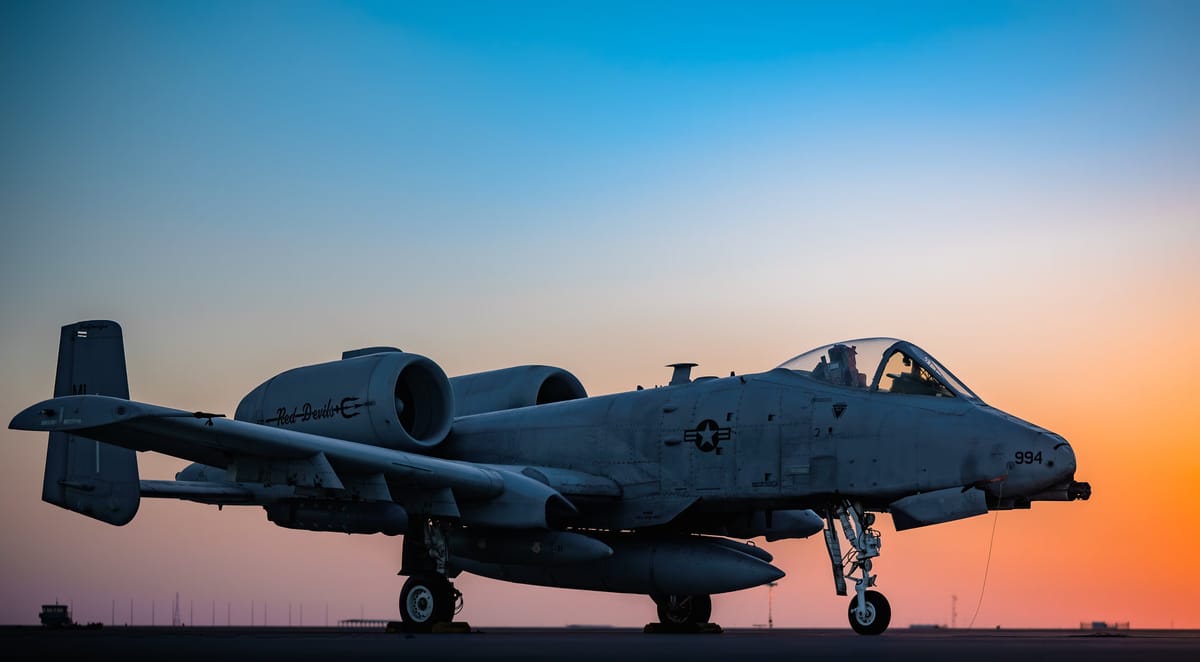
The A-10 exists because Vietnam proved that fast jets make lousy close air support platforms.
In the late 1960s, the Air Force was losing pilots and aircraft at alarming rates trying to provide ground support with F-100 Super Sabres, F-105 Thunderchiefs, and F-4 Phantoms — jets designed for speed and altitude, not for loitering low and slow over a battlefield finding targets in the trees. The Army, frustrated with Air Force CAS performance, started pushing for its own fixed-wing attack aircraft. The Air Force, terrified of losing the mission entirely, launched the A-X program in 1967 to build a dedicated close air support aircraft from scratch.
The requirements read like a wish list written by ground troops: low speed for target identification, long loiter time over the battlefield, massive weapons capacity, ability to operate from short and austere airstrips near the front lines, and — above all — survivability against ground fire. The aircraft had to take hits and keep flying. Not theoretically. Actually.
Fairchild Republic won the competition in January 1973 with the YA-10, beating Northrop’s YA-9 in a fly-off. But here’s the thing that makes the A-10 unique in all of aviation: the aircraft was designed around the gun. The General Electric GAU-8/A Avenger — a seven-barrel 30mm Gatling cannon nearly 20 feet long, heavier than a Volkswagen Beetle — was the starting point. Everything else — the airframe, the engines, the landing gear — was engineered to carry that gun into battle and bring the pilot home alive.
The design decisions were brutal and deliberate. Twin turbofan engines mounted high on the rear fuselage, shielded from ground fire by the tail structure. A titanium “bathtub” encasing the cockpit — 1,200 pounds of armor designed to withstand 23mm anti-aircraft rounds. Redundant hydraulic systems, manual flight control reversion if hydraulics fail completely, self-sealing fuel tanks, landing gear that extends by gravity if power is lost. The entire philosophy was: this aircraft will get shot. Build it to survive getting shot.
Named the Thunderbolt II after the legendary P-47 of World War II — another ugly, tough, ground-attack workhorse — it earned its real name from the troops immediately: the Warthog. Nobody who’s ever looked at one would argue. The saying among ground forces became “Go Ugly Early” — call in the A-10 first, before anything else, because nothing else does the job as well.
Fairchild delivered 715 aircraft between 1972 and 1984. The A-10 missed its moment in the spotlight initially — the Cold War Air Force was obsessed with nuclear delivery and air superiority, and CAS was the unglamorous mission nobody wanted. Then Desert Storm happened in 1991, and the Warthog destroyed more than 900 Iraqi tanks, 2,000 military vehicles, and 1,200 artillery pieces in 43 days. It flew 8,100 sorties — more than any other aircraft in the theater. Two A-10s were hit by surface-to-air missiles, suffered catastrophic damage, and flew home anyway. The mission capable rate was 95.7% — extraordinary for any aircraft, let alone one absorbing anti-aircraft fire daily. The legend was born.
From there, the Warthog went everywhere. Bosnia and Kosovo in the 1990s, providing CAS and CSAR (combat search and rescue) support. Afghanistan after 9⁄11, where it became the preferred platform for troops in contact — soldiers learned to love hearing “Hawg inbound” on the radio. Then-Lt. Col. Martha McSally, the first female fighter pilot to fly in combat, described why: “In Afghanistan… we used mostly the gun. It’s a very precise weapon and it allows for minimizing collateral damage and fratricide because the weapon’s footprint is so tight.”
Iraq from 2003 onward, flying thousands of sorties in direct support of ground forces. On April 7, 2003, Captain Kim “Killer Chick” Campbell took a surface-to-air missile over Baghdad that shredded her tail and killed her hydraulics. She switched to manual reversion — a backup system where mechanical cables directly move the control surfaces, no hydraulic assist — and flew the crippled jet an hour back to base in Kuwait. “It felt like the best landing I had ever done,” she said. “Any time you land and can walk away it’s good, but here the relief was… I can’t even describe to you what it was like being back on the ground.” Any other aircraft in the inventory, that’s a dead pilot and a lost airframe. The A-10 brought her home because absorbing catastrophic damage and continuing to fly is what it was designed to do. Operation Inherent Resolve against ISIS. And now, Operation Epic Fury over the Strait of Hormuz — a maritime mission nobody imagined when the A-X program launched in 1967, proving once again that the Warthog finds its purpose wherever the fighting is dirtiest.
The Retirement That Almost Was
In my B-1R piece, I wrote about the institutional error of discarding proven capability because it doesn’t fit the doctrine you’ve built around the wars you expect to fight. The B-1R was a $3 billion answer to an $80 billion question, and the Air Force chose the $80 billion answer. That was a mistake of imagination — failing to see what an existing platform could become.
The A-10 story is the mirror image: failing to see what an existing platform already is.
The Retirement That Almost Was
The Air Force has been trying to kill the Warthog for the better part of a decade. The fiscal year 2026 budget requested $57 million to decommission the remaining 162 A-10s — two years ahead of the previously stated retirement schedule. Congress blocked it, mandating a minimum fleet of 103 aircraft through September 2026.
Then Operation Epic Fury began. The Strait of Hormuz closed. And the aircraft the Air Force wanted to scrap became the one the joint force needed most.
The irony writes itself. As then-Congresswoman Martha McSally — herself an A-10 combat pilot — said when Congress blocked earlier retirement attempts: “I’m glad to see the administration recognize the flaws in seeking to eliminate the A-10 before we have a tested, proven replacement.”
No One Expects the Warthog Inquisition
Here’s where it gets interesting — and where the strategic lesson matters more than the platform debate.
Iran’s IRGC naval doctrine was built around the 2002 Millennium Challenge war game, where retired Marine Lieutenant General Paul Van Riper used unconventional swarming tactics to sink 16 American warships in the exercise’s opening phase. The Pentagon was so embarrassed they restarted the simulation with adjusted parameters.
Iran took notes. They engineered over 1,500 fast attack craft — composite and fiberglass hulls, mostly under 15 tons, running 50–70 knots, each carrying a Naser-1 anti-ship missile with a 35-kilometer range and terminal speed of Mach 0.9. Enough to mission-kill a frigate. The doctrine was simple: swarm, overwhelm, saturate. Force the defender to choose which threat to engage while knowing every defensive weapon fired costs more than every offensive boat it destroys.
It was a good plan. Against a single-service response, it might have worked.
Iran solved for the wrong equation.
The Cost Asymmetry That Broke the Doctrine
Let’s talk numbers, because this is where the A-10 argument becomes undeniable.
An SM-6 interceptor costs $5.3 million. A Harpoon runs $1.5 million and was designed for cruiser-sized targets, not composite skiffs. The Phalanx CIWS empties its magazine in 20 seconds and needs 4 minutes to reload. An Aegis destroyer carries 90–96 vertical launch cells, many already committed to Tomahawks, SM-2 interceptors, and ESSM quad packs.
Using those cells against a sustained swarm of $50K–$500K speedboats isn’t a doctrine. It’s a bankruptcy proceeding conducted at sea.
Now the A-10. The GAU-8/A Avenger fires 30mm depleted uranium rounds at 3,900 per minute. A standard 2-second combat burst puts 130 rounds into a fiberglass fast boat with no armor. Cost per engagement: under $10,000. For medium-range work, the AGM-65 Maverick runs $150K–$170K — still 30 times cheaper than the SM-6. APKWS laser-guided rockets cost roughly $35K per shot.
Across every distance inside the corridor, the A-10’s cost per kill runs between 30 and 500 times lower than the Navy’s available alternatives.
That’s not a marginal improvement. That restructures the entire economics of the engagement from the ground up.
Why This Aircraft, Specifically
Cost alone doesn’t make the argument. Any platform can theoretically deliver cheap munitions. What makes the A-10 the correct instrument at Hormuz is the simultaneous combination of characteristics that the environment demands — and that no other aircraft in the current inventory provides together.
Visual identification at low altitude. When 3,200 civilian vessels anchor in the Gulf and IRGC boats disperse among them, no radar signature, no electronic profile, and no algorithmic targeting solution substitutes reliably for a trained pilot at low altitude with a clear line of sight. An F/A-18E crossing the corridor at 500+ knots leaves every surface target in the pilot’s visual field for under 2 seconds. At the A-10’s patrol speed, the identification window extends two to three times longer. The pilot sees the rocket launchers bolted to the gunwale, confirms the military configuration, and fires.
That sequence is not physically possible at supersonic approach speeds. As British Army Major James Loden of the Parachute Regiment put it after fierce fighting in Afghanistan’s Helmand Province: “I’d take an A-10 over a Eurofighter [Typhoon] any day.” A U.S. NCO in Afghanistan told National Defense magazine: “The A-10s never missed, and with the F/A-18s we had to do two or three bomb runs to get them on the target.” Early in the Iraq war, 80 to 90 percent of ground force requests for air support specifically asked for the A-10.
Loiter time. The A-10 can remain on station for approximately 1 hour 50 minutes on internal fuel, extended to 2.5 hours with external tanks, flying racetrack patterns over the corridor. It doesn’t burn its endurance transiting hundreds of miles from a carrier and back. Its straight-wing configuration — the thing often cited as an “aerodynamic limitation” compared to swept-wing fighters — produces more efficient lift at low speeds, burns less fuel per hour in the patrol regime, and enables a turn radius tight enough that the aircraft can reverse its loop without ever departing the engagement zone.
What looks like a design constraint compared to the F-35 becomes a structural advantage inside a 6-mile maritime chokepoint.
Survivability. The pilot sits inside 1,200 pounds of titanium armor engineered to withstand 23mm armor-piercing rounds. Redundant hydraulic and control systems can sustain catastrophic battle damage and keep flying. The IRGC fires 12.7mm and 14.5mm machine guns at low-flying aircraft. A fast-moving strike jet avoids that threat by climbing out of range — surrendering the visual identification capability in the process. The A-10 absorbs the fire and continues the engagement, because absorbing that category of fire is precisely the engineering tradeoff its designers prioritized 50 years ago.
America’s Triple-Layer Kill Chain
What elevates Operation Epic Fury from a platform story to a strategic lesson is the joint architecture.
Army AH-64 Apaches operating alongside the Warthogs — staging from expeditionary sea bases, carrying up to 16 Hellfire missiles ($70K–$200K each) plus a 30mm chain gun. Apaches operate at lower altitude than the A-10 patrol layer, engaging threats that pass through the upper layer’s coverage. Meanwhile, Aegis destroyers preserve their vertical launch inventory for threats that actually justify the cost: anti-ship ballistic missiles, Mach-3 cruise missiles — capabilities nothing else in the joint force can stop.
CENTCOM also employed multiple 5,000-pound deep penetrator munitions against hardened underground storage facilities along Iran’s southern coastline, collapsing the supply infrastructure feeding the coastal defense systems.
The result: a layered system where the most capable and expensive weapons are reserved for the threats they were designed to defeat, while cheaper persistent tools handle the volume threats that would otherwise drain the expensive inventory dry.
No other military on earth could assemble this architecture. That isn’t rhetorical patriotism — it’s a structural observation. Integrating three service branches, each operating under distinct doctrine and equipment, into a coherent simultaneous layered defense over a single 6-mile corridor requires decades of joint training, interoperable comms, shared logistics, and a practiced culture of inter-service coordination that most militaries never develop.
Iran’s swarm doctrine was designed to exploit single-service dominance — a Navy-alone scenario. The IRGC engineered 1,500 fast attack craft to overwhelm 96 vertical launch cells on an Aegis destroyer. The arithmetic was deliberate. The strategy was solved for a scenario where the Navy answers the call without the Army and without the Air Force.
The joint architecture that materialized above the strait exploited none of those vulnerabilities.
But Wait — Can’t the B-1 Do This Job?
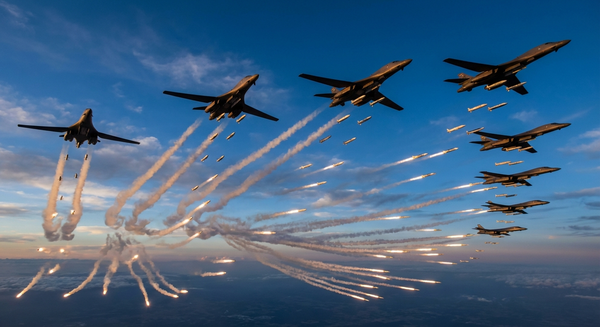
It’s a fair question. If you read my B-1R piece, you know I’m a Bone fanboy. And on paper, the comparison is surprisingly interesting.
The B-1B’s variable-geometry swing wings give it a split personality. Wings swept back at 67.5°, it’s a Mach 1.25 interceptor-fast missile truck. Wings forward at 15°, it slows down dramatically — landing speed at light weight is around 145 knots, which is roughly the A-10’s comfortable patrol speed of 150 knots. The two aircraft’s slow-speed envelopes nearly overlap.
And on loiter time, the Bone crushes the Warthog. The A-10 gets about 1 hour 50 minutes on station on internal fuel, maybe 2.5 hours with external tanks. The B-1B? It routinely flew 8–12 hour CAS missions over Afghanistan with tanker support. In Operation Enduring Freedom, the Bone would orbit for hours waiting for troops-in-contact calls, then drop JDAMs within minutes. It flew 2% of sorties and delivered over 40% of precision munitions. Ground troops loved hearing “Bone inbound” almost as much as “Hawg inbound.”
So the B-1B was already a pseudo-A-10 in Afghanistan. Can it be a “Super A-10” at Hormuz?
No. And understanding why is the whole point.
No gun. The B-1B has no cannon. The GAU-8/A Avenger is the weapon that makes the cost math work against speedboats — $10,000 per kill. The cheapest thing the Bone drops is an SDB II at $25,000+. A JDAM runs $25K–$40K. A JASSM runs over $1 million. Against a sustained swarm of $50K fiberglass boats, the Bone is using a $25,000 minimum buy-in per engagement where the Warthog spends under $10K. Multiply that across hundreds of engagements over weeks of sustained patrol, and the economics diverge by orders of magnitude.
Altitude floor. The B-1B operates at 200+ feet minimum, typically much higher for CAS. The A-10 gets down in the weeds at 50–100 feet, eyeballing targets. In a congested maritime lane with 3,200 civilian vessels and IRGC boats hiding among them, that low-altitude visual identification is the entire game. No radar signature or algorithmic targeting solution replaces a pilot’s eyes at 75 feet confirming rocket launchers bolted to a gunwale.
Speed problem in reverse. Even slowed down with wings full forward, the B-1B at 200 knots gives a pilot maybe 3–4 seconds to visually identify a military fast boat mixed among fishing dhows. The A-10 at 150 knots gives 6–8 seconds. In a rules-of-engagement-constrained environment where the penalty for misidentification is a war crime, those extra seconds are everything.
Zero armor. The Bone has no armor. None. It survives through speed, ECM, and terrain masking — not by absorbing hits. As Pierre Sprey — the Pentagon analyst who helped design both the F-16 and the A-10 — warned about using the F-35 for CAS: you would never want to risk a fragile $200 million stealth jet “down in the weeds” on low-level missions. The same applies to the $200 million B-1B. At low altitude over the Strait of Hormuz taking 14.5mm machine gun fire from coastal installations, it’s a glass jaw. The A-10’s 1,200-pound titanium bathtub shrugs off 23mm rounds and keeps flying. Different engineering philosophies, different survivability models, and at Hormuz, the A-10’s model is the right one.
Cost per flight hour. The B-1B runs approximately $70,000 per flight hour. The A-10 runs $6,000–$8,000. For sustained patrol operations over weeks — which is what holding a maritime chokepoint requires — that’s a 10x cost premium before you even count the munitions.
The B-1B is a magnificent aircraft optimized for a completely different problem. It’s the standoff missile truck — 24 JASSM-ERs from 500 miles out, then gone at Mach 2. The A-10 is the persistent low-altitude patrol — slow, cheap, armored, killing $50K speedboats for $10K a pop all day long.
They’re complementary, not substitutes. You need the scalpel and the sledgehammer and the guy with the wrench who shows up every day and doesn’t leave.
Connecting the Threads
In my Iran history piece, I wrote about the 50 years of tension that led to Operation Epic Fury — from the 1979 revolution to the February 28 strikes, the decapitation of Iranian leadership, and the B-2 daylight sorties. The strategic strikes on nuclear facilities and leadership compounds were the headline. But the Strait of Hormuz — keeping the world’s most critical energy chokepoint open while Iran threw everything it had at closing it — that’s the operational story that will be studied at war colleges for decades.
In the B-1R piece, I argued that retiring proven capability without exploring what it could become is “a capability gap dressed up as fiscal responsibility.” The B-1R could have delivered 192 JASSM-ER missiles from 8 aircraft — the standoff Mach 2 missile truck complementing the B-21’s stealth penetration role.
The A-10 at Hormuz proves the same principle from the opposite direction. The B-1R was about what a platform could become with investment. The A-10 is about what a platform already is — and about the catastrophic cost of discarding it before a replacement exists.
Both cases share the same institutional disease: optimizing for the war you expect rather than the war you get.
The Replacement Problem: F-35, Drones, and Turboprops
The Air Force’s official answer to “what replaces the A-10?” has been the F-35A Lightning II. Let’s be fair about what the F-35 brings to the table — and honest about what it doesn’t.
The F-35’s strengths are real. It has the most advanced sensor suite ever put in a fighter — the AN/APG-81 AESA radar, the Distributed Aperture System that gives pilots 360-degree infrared awareness, and helmet-mounted displays that fuse all of it into a single picture. Its datalink capability means it can coordinate strikes across an entire theater. In a contested airspace with advanced SAMs, the F-35’s stealth is the difference between getting the mission done and getting shot down. Against a peer adversary like China or Russia, you want F-35s. Full stop.
But CAS isn’t a peer air superiority mission. And the numbers don’t lie.
The F-35A’s cost per flight hour is approximately $42,000 (GAO). The A-10’s is roughly $22,500. That’s nearly a 2:1 ratio just to keep the aircraft airborne — before you factor in the munitions cost gap. The F-35 can loiter over a battlefield for about 1.5 hours in a permissive environment with tanker support. The A-10 does 2.5 hours on external tanks alone, from a base 50 miles away instead of 500. And the F-35 carries a 25mm GAU-22/A cannon with 182 rounds — compared to the A-10’s 1,150 rounds of 30mm. A single burst from the F-35 and the magazine is functionally depleted for gun work. That’s not a CAS weapon. That’s a last resort.
The deeper problem is philosophical. The F-35 is a $100 million stealth aircraft (unit cost, not counting sustainment). No sane commander sends it to fly at 200 feet over the Strait of Hormuz absorbing 14.5mm fire to identify speedboats. You can’t afford to lose one doing that mission. The A-10 was designed to absorb exactly that punishment because its designers understood that CAS aircraft will take hits — and built accordingly. The F-35’s designers optimized for a completely different threat model, and that’s fine. It’s just the wrong tool for this job.
The Air Force even conducted a comparative fly-off between the A-10 and F-35 for the CAS mission. The results were classified. Draw your own conclusions about what happens when the military classifies a test that was supposed to prove their preferred platform was better.
What about drones? The MQ-9 Reaper is the most commonly cited unmanned replacement. It loiters for 14+ hours, carries Hellfires and JDAMs, and costs roughly $4,700 per flight hour — cheaper than the A-10. For permissive environments with time-insensitive targets, the Reaper is excellent. But it has zero survivability against any air defense more sophisticated than a rifle. No armor, no redundancy, no ability to absorb damage. It flies at 230 mph max — fast enough to patrol, too slow to evade. At Hormuz, with IRGC coastal defense guns, MANPADs, and the constant threat of Iranian fighters, the Reaper is a sitting duck. Drones are part of the future CAS picture, but they’re not the whole picture.
Light attack turboprops — the A-29 Super Tucano, the AT-6 Wolverine — were explored under the Air Force’s Light Attack Experiment (OA-X) program. Cost per flight hour around $1,000–$3,000. Excellent for counter-insurgency in permissive airspace — Afghanistan, Africa, low-intensity conflicts. But they carry a fraction of the A-10’s weapons load, have zero armor, and would be shredded by the kind of air defenses Iran fields. They solve a different problem — the counter-terrorism patrol problem, not the contested maritime chokepoint problem.
Here’s the uncomfortable truth: no single platform in development or production replaces the A-10’s specific combination of capabilities — low-speed loiter, heavy weapons load, massive cannon, pilot survivability against ground fire, and low operating cost. The F-35 is too expensive and too fragile for the mission. Drones are too vulnerable. Turboprops are too light. Each fills a piece of the CAS mission. None fills all of it.
The Air Force’s answer has been to spread the CAS mission across multiple platforms. That’s not inherently wrong — but it’s more complex, more expensive, and introduces seams that an enemy can exploit. The A-10 solved the CAS problem with one aircraft because it was designed to solve that specific problem. Its replacement, whatever it is, needs to be designed with the same single-minded focus. So far, nothing has been.
The Question That Matters
The A-10 will eventually retire. Titanium armor and seven-barrel Gatling cannons don’t operate indefinitely. Operation Epic Fury hasn’t resolved the retirement debate — it’s made the debate considerably more expensive to resolve incorrectly.
The capability gap the Warthog fills doesn’t disappear when the airframe does. Fifth-generation fighters have performed effectively against Iran’s air defenses and hardened infrastructure during Epic Fury, but their continued use against cheap one-way attack drones and fast boats is economically unsustainable at scale. The F-35 is a remarkable aircraft optimized for a specific threat environment. That environment does not include hunting composite speedboats at low altitude over a congested 6-mile shipping lane.
The question Congress and the Air Force must answer isn’t whether to keep the Warthog forever. The question is whether a successor capability exists that fills the same operational niche at comparable cost and effectiveness.
If the answer is no — and at this writing, the answer appears to be no — then retiring the platform before that successor is fielded isn’t a budget decision. It’s a capability decision.
The Strait of Hormuz won’t be the last such corridor. Taiwan Strait. Bab el-Mandeb. The contested island approaches of the South China Sea. Environments with the same structural characteristics: confined spaces, asymmetric threats, swarm tactics, and civilian vessel density that makes high-speed precision strike operationally difficult.
The Bottom Line
The A-10 was almost retired because it didn’t fit a doctrine built around the wars planners expected to fight. The Strait of Hormuz was the war that actually arrived. The aircraft the Pentagon wanted to discard for $57 million is the one currently holding open one of the world’s most critical energy chokepoints — destroying fast boats for under $10K per engagement while $5.3 million interceptors stay in their cells for threats that justify the price.
I wrote in the B-1R piece: “Stealth isn’t everything. Sometimes you don’t need to sneak in — you need to kick in the door with a hundred cruise missiles and leave at twice the speed of sound.”
The A-10 corollary: Speed isn’t everything. Sometimes you don’t need to go fast — you need to go slow, go cheap, and stay all day.
The Warthog was right all along. The question is whether we’ll learn the lesson before we throw away the next platform that doesn’t fit the doctrine — but fits the war.
“Eventually we’ll have better bombers than the B-1B; but we’ll never have sexier bombers than the B-1B.” — Jonathan Taylor
And the A-10? We may build faster aircraft. More stealthy aircraft. More expensive aircraft. But we will never build a more honest aircraft — one where every design decision was made for combat effectiveness rather than procurement convenience. The Strait of Hormuz is where that honesty was vindicated under live fire.
This article builds on two previous pieces: The Case for the B-1R and From Revolution to “Operation Epic Fury”. Together, they trace a thread: proven military capability is fragile not because the hardware fails, but because institutions choose to abandon it before the next war proves them wrong.
Sources: @amuse on X, USAF A-10 Fact Sheet, Congressional Research Service, Millennium Challenge 2002 (Wikipedia), GlobalSecurity.org, Dan Grazier / Stimson Center