The New Arsenal of Democracy

There’s a moment in every generation when the shape of the future becomes clear—not in hindsight, but in real-time, for anyone willing to look. For my generation, that moment is now. And the future is being decided between exactly two countries: the United States and China.
No disrespect, but no other nation or union of sovereign states matters in this race. Not Europe, comfortably declining into regulatory theater. Not Japan, demographically frozen. Not India, still decades from industrial parity. This is America versus China, full stop.
I write this as someone who lived it from the inside. At Voxeo we acquired a company in China—SIPMethod, a VoIP technology firm. I spent years working with Chinese engineers and entrepreneurs. I admire the Chinese people. Their work ethic is extraordinary. Their ingenuity is real. Their government, however, is playing a very different game than we are—and they’re playing to win.
The Numbers Should Terrify You
Let me lay out what I’ve been studying:
- Five Chinese defense companies now rank in the world’s top 10 by revenue. A decade ago? Zero in the top 100.
- China controls 53% of global shipbuilding capacity. The US? 0.1%.
- US defense spending sits at 3% of GDP—the lowest since the Cold War began.
- Xi Jinping has directed the PLA to be ready for conflict by 2027.
Meanwhile, we’ve let our industrial base atrophy. Javelin missiles take two years to produce. Factory expansion requires years for real estate and infrastructure. We’ve optimized for “exquisite systems”—beautiful, expensive, slow—while China optimizes for scale.
This isn’t speculation. This is what happens when you spend three decades offshoring manufacturing capability to a strategic competitor.
The AI Irony: How We Made Them Better
Our attempts to hinder Chinese AI via export restrictions on advanced Nvidia chips to China didn’t work. They didn't cripple Chinese AI. They forced Chinese researchers to get better.
When you can’t access Nvidia H100s with massive VRAM and fast interconnects, you do what engineers have always done—you innovate around the constraint. Chinese AI labs have become world-class at building models that use less memory, require less bandwidth, and run on inferior hardware.
DeepSeek, Qwen, and others aren’t just “catching up.” They’re pioneering efficient architectures that can deploy on commodity hardware at massive scale. We handed them 80% capable GPUs and they built 120% better software.
Meanwhile, American AI companies burn billions on compute-intensive approaches that require data center scale infrastructure. We’re building Ferraris. They’re building Toyotas. And in a war—hot or cold—you need ten million Toyotas, not one hundred Ferraris.
What Must Happen
I see three imperatives:
1. Revitalize American Manufacturing
FDR’s “Arsenal of Democracy” speech in 1940 launched the most remarkable industrial mobilization in human history. Within two years, we went from producing fewer aircraft than any major power to producing more than all of them combined.
We did this before. We can do it again. But it requires treating manufacturing as a strategic priority, not a cost center to offshore. It means investing in vocational training, making factory jobs prestigious again, and accepting that some industries need to exist on American soil regardless of short-term economics.
2. Build the New Arsenal of Democracy
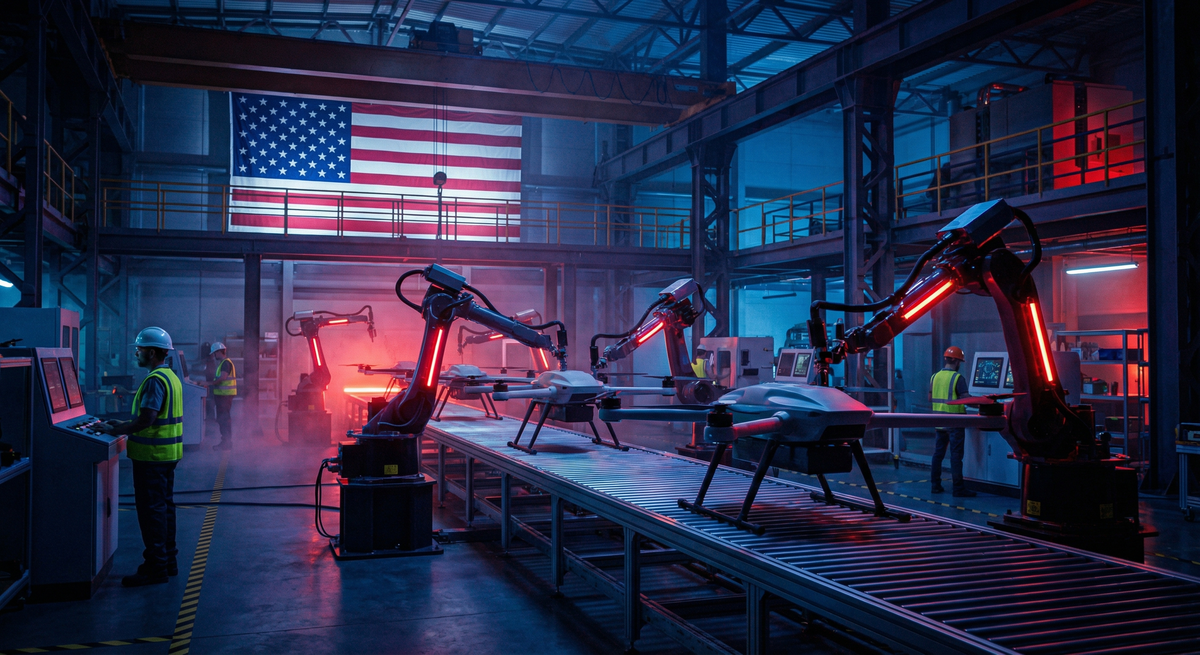
The original arsenal built tanks and bombers. The new one must build drones, autonomous systems, and AI infrastructure. We need to shift from exquisite weapons systems to mass-producible platforms.
This is why I co-founded DroneScale with Doug George. The mission statement is simple: “We will not rest until the USA can build 10 million drones every year.”
Every component possible sourced domestically. Every line of code written on US soil. No critical foreign dependencies. This isn’t nationalism—it’s survival.
3. Close the AI Efficiency Gap
American AI has become addicted to scale. Bigger models, bigger clusters, bigger budgets. This approach works when you have unlimited capital and uncontested access to advanced chips.
But that’s not the world we live in. We need American AI labs to get serious about efficiency. Not because it’s elegant, but because the alternative is deploying AI that only works in controlled data center environments while China deploys AI that runs on commodity hardware everywhere.
The companies doing this work—optimizing for inference cost, building smaller models that punch above their weight, deploying at the edge—deserve more attention and capital than they’re getting.
Churchill’s Warning
In 1935, Winston Churchill warned Parliament about German rearmament. He was ignored. He famously described it as the “unwillingness to act when action would be simple and effective.”
We’re in that moment now. The cost of preparation is far cheaper than the cost of a great power conflict. We still have innovative advantages—SpaceX, General Atomics, the remaining capability in American engineering talent. But advantages decay when you don’t use them.
The top six tech companies spend nearly 20x what the top six defense contractors spend on R&D. Apple, Nvidia, Microsoft, and Google are investing more in the future than Boeing and Lockheed Martin combined. We need those innovation engines pointed at national challenges, not just consumer products.
The Choice
This isn’t a policy paper. It’s a statement of what I see happening and what I believe must happen in response.
I’ve built companies. I’ve written code. I’ve watched American technology transfer to China for thirty years. I’ve seen Chinese engineers build incredible things with less than we have. I’ve watched American institutions become complacent, assuming that our lead was permanent.
It’s not permanent. Nothing is.
The question is whether we have the will to do what previous generations did: recognize a threat, mobilize our industrial capacity, and build our way to security.
I’m betting on America. That’s why DroneScale exists. That’s why I’m writing this.
But betting isn’t enough. We need to build.
Jonathan Taylor is a technology entrepreneur and investor. He previously founded and sold multiple SaaS and software companies. He currently co-leads DroneScale, focused on American drone manufacturing at scale.