The Case for the B-1R

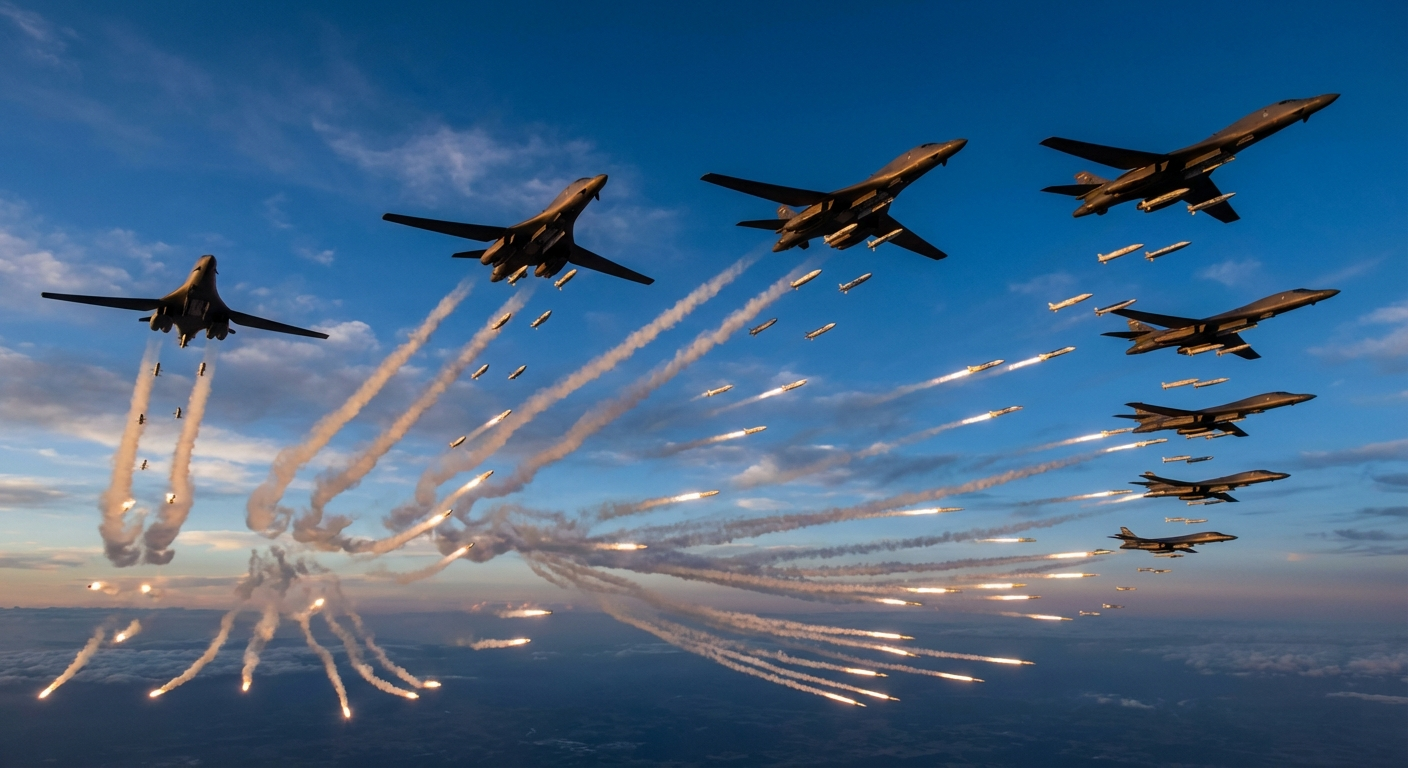
Don’t Let ‘Em Go To Waste
Sometimes the best solution isn’t the shiniest one — it’s the one you already have, made faster and meaner.
B-1B History: Born, Killed, Reborn
The B-1 story starts in the early 1970s, when the Air Force wanted a replacement for the aging B-52 Stratofortress. Rockwell International won the contract and delivered the B-1A — a gorgeous, variable-geometry swing-wing bomber capable of Mach 2.2 at altitude. It was everything SAC wanted: fast, low-flying, nuclear-capable, and terrifying.
Then Jimmy Carter killed it in 1977.
Carter’s reasoning wasn’t entirely wrong — cruise missiles and the nascent B-2 stealth program seemed like better bets than a penetrating bomber. But Ronald Reagan disagreed. In 1981, he revived the program as the B-1B, a modified version optimized for low-altitude penetration rather than high-altitude speed. First flight came in 1984, Initial Operational Capability in 1986, and Rockwell ultimately built 100 airframes at a total program cost that ballooned well past original estimates — roughly $28 billion in then-year dollars.
The trade-offs from the A to the B model were significant. The B-1B’s top speed was limited to Mach 1.25 — nearly half the B-1A’s Mach 2.2 capability. Rockwell added fixed engine inlet geometry (with radar-blocking vanes) to reduce radar cross section, beefed up the airframe for low-altitude terrain-following flight, and increased fuel capacity. The B-1B got a reduced RCS of roughly 1 square meter — about 1/100th of the B-52 — but it surrendered that blistering speed.
It was built to fly fast and low into Soviet airspace, drop nuclear bombs, and fly home. That was the entire job description. Nobody imagined what it would actually become.
Advancements Since the 80s: From Nuclear Orphan to the Crews’ Favorite
The B-1B’s early years were rough. The defensive avionics suite was plagued with problems. The jet missed Operation Desert Storm in 1991 entirely — it simply wasn’t ready for conventional operations. For a bomber that cost $28 billion, sitting out the biggest air war since Vietnam was not a great look.
But the Air Force didn’t give up on the Bone. The Conventional Mission Upgrade Program (CMUP) transformed it from a nuclear-only platform into a precision conventional bomber. Block upgrades added GPS-aided munitions capability, starting with cluster bombs and eventually JDAM integration that changed everything.
The B-1B’s combat debut came during Operation Allied Force over Kosovo in 1999 — and it was a statement. Six B-1Bs flew just 2% of all strike missions but delivered 20% of the total ordnance. The weapons bay capacity was staggering compared to tactical fighters.
Then came Afghanistan, and the Bone became a legend.
During the first six months of Operation Enduring Freedom, B-1Bs dropped nearly 70% of all JDAM tonnage delivered in the theater. Flying 2% of the sorties, delivering 40%+ of the precision weapons. The math was absurd. One B-1B sortie could deliver what would take a dozen F-16 sorties to match. Crews called in from ground-level TIC (troops in contact) situations learned to love hearing “Bone inbound” on the radio.
The upgrades kept coming: SNIPER Advanced Targeting Pod integration gave crews their own precision targeting eyeball. Synthetic Aperture Radar (SAR) upgrades enabled ground mapping and targeting in any weather. Link-16 datalink connected the Bone to the networked battlefield. And critically, integration of the AGM-158 JASSM and AGM-158C LRASM gave it standoff strike capability against land and sea targets at ranges exceeding 500 nautical miles.
The jet that nobody wanted in 1991 became the bomber everybody wanted by 2005. Crews loved it. Ground troops loved it. Combatant commanders couldn’t get enough of it. The “Bone” — B-One, get it? — had found its identity.
As one B-1B pilot put it: “There is no other aircraft in the inventory that can do what we do — loiter for hours, carry this much ordnance, and put it on target with this kind of precision.”
B-1B Retirement Plan: Sending the Bone to the Boneyard
Here’s where the story gets frustrating.
The Air Force’s current plan is to retire the entire B-1B fleet to free up funding and maintenance personnel for the B-21 Raider. The fleet has already been slashed from 100 airframes to roughly 45 operational aircraft. The rest have been sent to the 309th Aerospace Maintenance and Regeneration Group at Davis-Monthan AFB — the Boneyard.
The justification is straightforward: the remaining jets are tired. Decades of low-altitude operations, high-g maneuvering (yes, for a bomber), and relentless combat deployments have taken their toll. Structural fatigue is a real problem. Fuel leaks are chronic. The wings — those beautiful variable-geometry swing wings — are maintenance nightmares. The Air Force has called the B-1B a “bridge bomber” — something to use until the B-21 arrives in sufficient numbers.
Full retirement is expected by the late 2030s.
And look, I get it. Maintenance costs are real. Structural fatigue is real. But here’s the thing — re-engining solves half the maintenance problem on its own. The F101 engines are 1970s technology with 1970s maintenance demands. The F119 has fewer moving parts, better materials, and decades of reliability data from the F-22 program. Boeing’s B-1R proposal estimated that the engine swap alone would reduce per-flight-hour maintenance costs by 25-30%.
As for airframe fatigue, the B-1B fleet isn’t uniformly worn out. Of the ~45 remaining operational jets, many have significantly different flight-hour totals. The Air Force could cherry-pick the 20-30 lowest-time airframes for B-1R conversion, perform structural life extension (new wing carry-through boxes, bulkhead reinforcements) as part of the re-engining depot work, and get another 15-20 years of service life out of them. Structural life extension programs are routine — the B-52 has been through multiple rounds and is expected to fly past 2060 with airframes built in the early 1960s. The KC-135 fleet is even older. If a B-52 can fly for 100 years, a B-1B can certainly manage 50 with the right investment.
The “they’re too tired” argument is a choice, not a fact. It’s a maintenance funding decision dressed up as an engineering limitation.
But retiring the Bone without exploring what it could become? That’s where the Air Force got it wrong.
Don’t Let ‘Em Go — The B-1R Proposal
In 2004, with operations in Iraq and Afghanistan stretching the bomber fleet thin, Boeing proposed something brilliant: the B-1R.
The “R” stood for Regional. The concept was straightforward but transformative: take existing B-1B airframes and re-engine them with Pratt & Whitney F119 turbofans — the same engines that power the F-22 Raptor.
The numbers were compelling. The F119 is actually lighter than the existing F101 (3,900 lbs vs 4,400 lbs), narrower (46 inches vs 55 inches diameter), and produces significantly more thrust — 35,000 lbs in afterburner vs 30,800 lbs, and a massive advantage in dry thrust: 26,000 lbs vs 17,400 lbs. That dry thrust advantage meant better fuel efficiency at cruise, lower maintenance costs (fewer parts, newer technology), and dramatically improved performance.
The headline number: Mach 2.2. The B-1R would restore — and even exceed — the original B-1A’s speed capability. It would also get a new AESA radar, fully functional external hardpoints, and — this is the wild part — the ability to carry AIM-120 AMRAAM air-to-air missiles for self-defense.
The estimated cost? Roughly $3 billion to convert the fleet. Compare that to the B-21 Raider program, which is projected at $80+ billion for approximately 100 aircraft.
Three billion dollars. For a Mach 2.2 missile truck with a 75,000-pound payload.
The Air Force passed. They wanted stealth, not speed. The Next-Generation Bomber program — which eventually became the B-21 — was the priority. The B-1R died on the briefing room floor.
I believe this was a historic mistake.
Re-engined Mach 2.0 Missile Truck: What Could Have Been
Let’s paint the picture of what a modernized B-1R would look like in 2026.
Start with the airframe’s raw capacity. The B-1B has three internal weapons bays and six external hardpoints. Total payload capacity: 75,000 pounds — the largest of any aircraft in the U.S. inventory. For context, the B-21 Raider’s payload is estimated at roughly 30,000 pounds. The B-52 carries about 70,000 pounds but at a third of the speed.
A B-1R could carry 24+ JASSM-ER cruise missiles internally, or a mixed loadout of LRASM anti-ship missiles, JASSM-ERs, SDB IIs, and potentially hypersonic weapons on the external pylons. Each sortie delivers what an entire squadron of F-35s would struggle to match.
Now add speed. Mach 2.0+ means the B-1R gets to the fight faster, spends less time in threat envelopes, and can rapidly reposition across a theater. Speed isn’t just about getting there — it’s a survivability feature. An aircraft doing Mach 2.0 at altitude is geometrically harder for SAMs to engage. The engagement window shrinks. The missile’s energy advantage diminishes. You can’t hit what you can’t catch.
And with the F119’s superior dry thrust, the B-1R would cruise supersonically without afterburner — supercruise, just like the F-22. Range would decrease roughly 20% compared to the subsonic B-1B, but we’re still talking about 4,000+ nautical miles unrefueled — and that’s with a full weapons load.
The B-21 is stealthy. The B-1R would be fast and heavy. Different tools for different jobs. Why not have both?
Why It Would Have Been Ideal in Iran
Let’s talk about a scenario that’s been on the Pentagon’s whiteboard for two decades: striking Iran’s nuclear facilities.
Iran’s air defense network is no joke. They’ve deployed the Russian S-300PMU2 and developed their indigenous Bavar-373 system. Their facilities are deliberately dispersed and hardened — Natanz is buried, Fordow is built inside a mountain under 80 meters of rock. The country’s mountainous terrain creates radar shadows and complicates ingress routes.
Now imagine a flight of eight B-1Rs.
They launch from Al Udeid or Diego Garcia. At Mach 2.0, they cross the Persian Gulf and launch 192 JASSM-ER missiles from standoff range — outside Iranian airspace entirely, from over international waters or friendly territory. The missiles fly 575+ nautical miles to their targets. By the time Iranian air defenses even detect the incoming salvo, the B-1Rs are already egressing at Mach 2, rapidly opening the distance.
To accomplish the same strike with F-35s, you’d need dozens of aircraft, extensive tanker support, SEAD/DEAD packages to suppress air defenses, and you’d be putting stealth fighters inside the threat envelope. The F-35 carries 2 JASSM internally (4 with external carriage, but then you’ve lost your stealth). You’d need 48 F-35 sorties to deliver what 8 B-1Rs could deliver in a single wave.
The math is brutal. And the B-1R doesn’t need to be stealthy because it’s shooting from outside the defense envelope and running away at twice the speed of sound.
Air-to-Air and Air-to-Surface Missiles: The Arsenal Ship of the Sky
Here’s where the B-1R concept gets truly wild.
Boeing’s original proposal included air-to-air missile capability — specifically, AIM-120 AMRAAM integration. A bomber carrying air-to-air missiles isn’t as crazy as it sounds. The concept has historical precedent — the Air Force studied B-52 self-defense missile concepts during the Cold War. The Soviet Tu-128 “Fiddler” was essentially a bomber-sized interceptor carrying long-range air-to-air missiles.
The modern “missileer” concept takes this further. A B-1R with an AESA radar could detect and engage aerial threats at long range. It wouldn’t dogfight — it would launch AMRAAMs from beyond visual range while doing Mach 2. Good luck chasing that down.
But the real magic is in the standoff weapons loadout:
- AGM-158B JASSM-ER: 575+ nm range, 1,000 lb warhead, stealthy cruise missile
- AGM-158C LRASM: Long-range anti-ship missile, autonomous targeting
- AGM-88G AARGM-ER: Anti-radiation missile for SEAD/DEAD
- GBU-53/B SDB II: Small Diameter Bomb with tri-mode seeker, 40+ nm glide range
- AGM-183A ARRW: Air-launched hypersonic boost-glide weapon (Mach 6.5+)
- HACM: Hypersonic Attack Cruise Missile, air-breathing scramjet
A single B-1R could carry a mixed loadout of all of these. Imagine: 12 JASSM-ERs for land targets, 8 LRASMs for ships, 4 AMRAAMs for self-defense, and 2 hypersonic weapons for time-sensitive targets. One aircraft. One sortie. A flying arsenal ship that can strike land, sea, and air targets while outrunning most threats.
War with China / Asia Pacific: The Tyranny of Distance
The Pacific is defined by distance. From Guam to the Taiwan Strait is roughly 1,500 nautical miles. From Darwin, Australia to the South China Sea is over 2,000 nm. From Hawaii to anywhere that matters is over 3,000 nm.
This is where the B-1R concept becomes not just nice-to-have, but strategically essential.
A B-1R operating from Guam, Diego Garcia, or northern Australia could:
- Launch LRASM salvos against PLAN surface action groups from standoff range. A flight of 8 B-1Rs could put 192 anti-ship missiles in the air in a single coordinated strike. That’s enough to threaten an entire carrier battle group — twice over.
- Strike A2/AD positions — anti-ship ballistic missile launchers, radar installations, command nodes — with JASSM-ER from outside the threat envelope.
- Rapidly reposition across the theater. At Mach 2.0, a B-1R can cover 1,500 nm in about an hour. An emerging target near the Spratlys? A B-1R orbiting east of the Philippines can be in launch range in 45 minutes.
Compare this to the B-21. The Raider is stealthy and can penetrate defended airspace — that’s its superpower. But it carries roughly half the payload of the B-1R, flies at subsonic speeds (estimated Mach 0.85), and the Air Force plans to buy only 100 airframes total. In a Pacific conflict against China, those 100 B-21s will be spread thin across multiple missions.
The B-1R wouldn’t replace the B-21. It would complement it. The B-21 penetrates and strikes the hardest targets. The B-1R handles the volume — saturating defenses with mass, delivering standoff weapons at speed, and covering the vast distances of the Pacific faster than anything else in the inventory.
Speed and mass. In the Pacific, those matter as much as stealth.
War with Russia: Speed Kills
A European/Arctic conflict with Russia presents different challenges, but the B-1R answer remains compelling.
Response time from CONUS: A B-1R at Mach 2.0 can reach the European theater from the continental U.S. significantly faster than any subsonic bomber. With tanker support, you’re looking at single-digit hours from wheels-up to weapons release.
JASSM-ER strikes on hardened targets: Kaliningrad — Russia’s most fortified exclave in Europe — is bristling with S-400 batteries, Iskander missiles, and Bastion coastal defense systems. A B-1R doesn’t need to get close. From over Poland or the Baltic Sea, it launches JASSM-ERs at 575+ nm range. The missiles do the penetrating.
Mach 2 survivability: Russia’s S-400 and next-generation S-500 systems are formidable. But engagement geometry matters. An aircraft doing Mach 2.0 at 40,000+ feet presents a fundamentally different targeting problem than a subsonic bomber at the same altitude. The engagement window compresses. The missile’s energy budget gets stressed. And if the B-1R is launching standoff weapons from 500+ nm away, the SAM problem becomes largely irrelevant.
Volume of fire: This is the killer argument. A single B-1R sortie can deliver 24+ standoff cruise missiles. Eight aircraft deliver nearly 200. In a conflict where overwhelming integrated air defenses is essential, mass matters. You need enough missiles in the air simultaneously to saturate defensive systems. The B-1R delivers that mass more efficiently than any other platform in the inventory.
Against the Kola Peninsula’s submarine bases and Northern Fleet facilities, against Kaliningrad’s fortress, against strategic targets in western Russia — the B-1R’s combination of speed, range, and payload is exactly what the doctor ordered.
Elsewhere: The Bone Does Everything
The B-1B already proved it can do everything.
In Afghanistan, it became the go-to close air support platform — a phrase nobody would have predicted in 1986. Troops in contact would call for air support, and a B-1B orbiting overhead at 25,000 feet could put a JDAM on a Taliban position within minutes. The loiter time was extraordinary. The precision was surgical. And the psychological impact of 900+ mph low passes (the famous “show of force”) broke enemy will to fight.
A B-1R would do all of this faster.
In the Middle East, Africa, or any low-intensity conflict zone, speed means faster response time. When a special operations team calls for help, every minute matters. A B-1R cruising at Mach 1.5+ gets to the fight in half the time of a subsonic platform.
Counter-terrorism strikes against time-sensitive targets — an ISIS leader’s convoy, a terrorist meeting — reward speed above all else. The target won’t wait. The B-1R wouldn’t make them wait either.
From high-end peer conflict to counter-insurgency, from anti-ship warfare to close air support, the Bone has already proven its versatility. The B-1R would amplify every one of those capabilities.
Conclusion: Keep the Bone, Build the B-1R
Let me be clear: the B-21 Raider is the future of the bomber force. It’s a remarkable aircraft, and the Air Force needs every one of the 100 planned airframes. Stealth penetration capability against peer adversaries is non-negotiable.
But retiring the B-1B fleet without exploring a B-1R conversion isn’t strategic wisdom — it’s a capability gap dressed up as fiscal responsibility.
The B-21 does stealth. Nothing else can do what it does. But it carries less than half the payload of a B-1B, flies at subsonic speeds, and 100 airframes isn’t enough to be everywhere at once in a global conflict.
The B-1R fills the gap that the B-21 can’t: mass, speed, and payload.
For roughly $3 billion — a rounding error in Pentagon terms — the Air Force could convert 20-30 B-1B airframes into B-1Rs with new F119 engines, AESA radar, and modern avionics. That’s less than the cost of a single Virginia-class submarine. Less than a single year of F-35 sustainment costs. Less than the cost overrun on half a dozen other DoD programs.
What would you get for that $3 billion? A fleet of Mach 2.0+ missile trucks, each capable of carrying 75,000 pounds of ordnance, delivering 24+ cruise missiles per sortie, with the range to operate across the Pacific and the speed to outrun most threats. A complement to the B-21, not a competitor. The penetrating bomber and the standoff arsenal ship, working together.
Stealth isn’t everything. Sometimes you don’t need to sneak in — you need to kick in the door with a hundred cruise missiles and leave at twice the speed of sound.
The B-1R was a $3 billion answer to an $80 billion question. The Air Force chose the $80 billion answer, and that’s fine — we need the B-21. But we needed the B-1R too.
Don’t let ‘em go. Not without a fight.
“Eventually we’ll have better bombers than the B-1B; but we’ll never have sexier bombers than the B-1B.” — Jonathan Taylor
And the B-1R? It would be all three: sexy, dominant, and deadly.
Sexy: The B-1B is already the most beautiful military aircraft ever built — those variable-geometry swing wings, the blended body, the aggressive stance on the ramp. The B-1R wouldn’t change the lines. It would just make them faster. Mach 2.0+ in the same gorgeous airframe. Nothing the Air Force has ever flown — or will fly — looks this good moving this fast.
Dominant: 75,000 pounds of payload — more than any other combat aircraft in the U.S. inventory. Eight B-1Rs deliver 192 standoff weapons in a single wave. That’s more firepower per sortie than an entire carrier air wing. At Mach 2.0+, it can reposition across a theater in under an hour, strike, and be gone before the enemy can react. The F119 engines deliver 40% more dry thrust than the F101s, meaning supercruise capability — sustained supersonic flight without afterburner — just like the F-22.
Deadly: A B-1R carrying JASSM-ERs can destroy 24 hardened targets from 575+ miles away. With LRASMs, it can sink a surface fleet. With AMRAAMs, it can defend itself. With hypersonic weapons, it can kill time-sensitive targets that nothing else can reach fast enough. It operates above the engagement envelope of most MANPADS and tactical SAMs, outruns the engagement geometry of most strategic SAMs, and delivers precision weapons at ranges that keep it outside the threat entirely.
The B-21 is the scalpel. The B-1R is the Mach 2 sledgehammer.
We need both.
Sources: USAF B-1B Fact Sheet, The Aviation Geek Club, Air Force Magazine, Congressional Research Service, GlobalSecurity.org, The War Zone / The Drive, National Interest, Scott Lowther’s “US Supersonic Bomber Projects”