Make Your Mistakes in China; Make Your Products in the USA

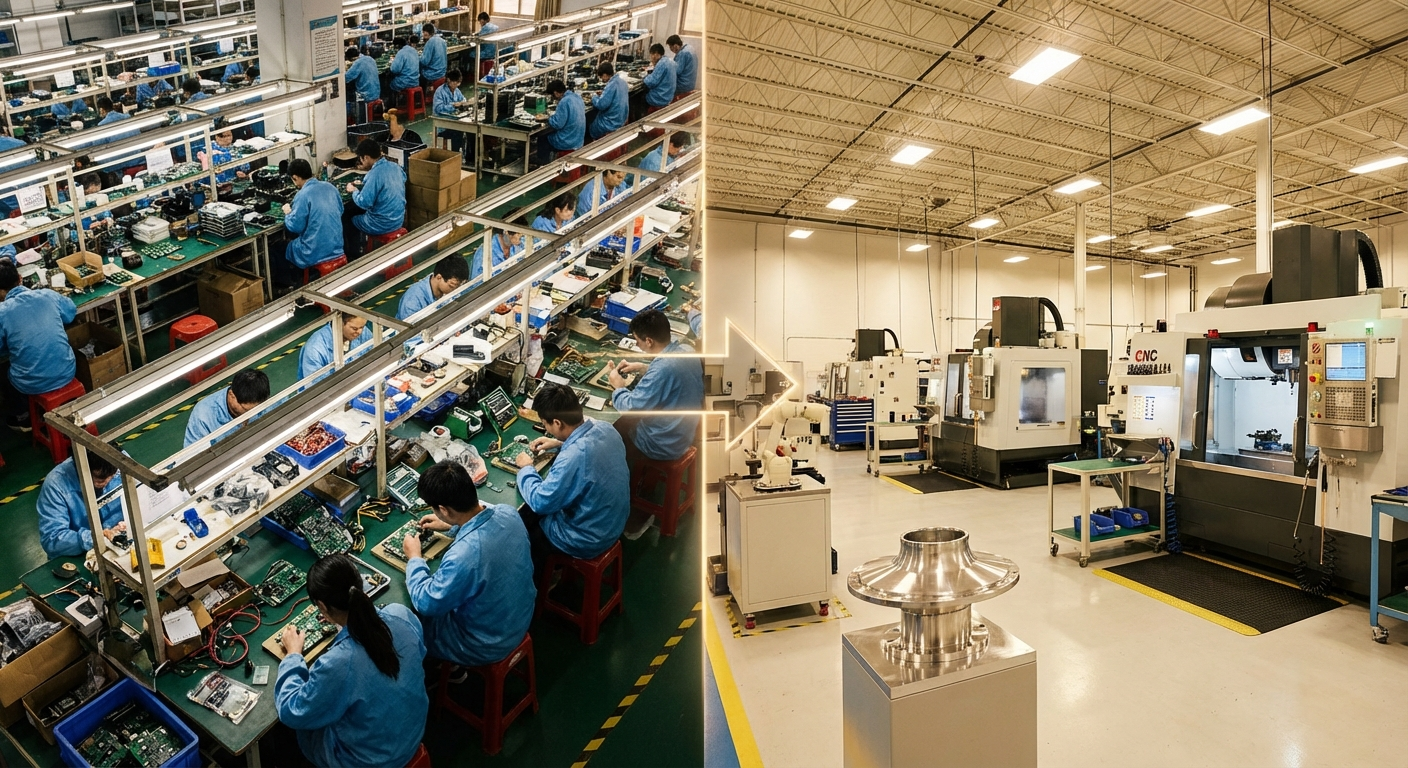
TL;DR: China’s manufacturing ecosystem lets you iterate on hardware prototypes at a speed and cost the US can’t touch — yet. We learned this firsthand building the Sighthound Gen 5 camera enclosure and boards. The play: make your mistakes in China, get to your 1.0, then manufacture in America. The US needs to get radically better at “mistake engineering” — the ability to fail fast, cheap, and often. Some companies are already doing it. Here’s what we learned, who’s leading the way, and a plan for how America can close the gap.
I’ve spent my career in software. Sprints. Standups. Ship fast, break things, iterate. The entire software industry is built on the assumption that mistakes are cheap.
Then we started building hardware.
Circuit Boards Don’t Have an Undo Button
At Sighthound, we build edge AI compute devices — cameras and nodes with custom circuit boards, aluminum extrusions, IP68-rated enclosures, gaskets, cables, thermal solutions, the works. Our Gen 5 camera packs a 4K Sony STARVIS sensor and an NVIDIA GPU into a passively cooled, weather-sealed package that runs AI inference at the edge.
Building that product taught us something the software world rarely confronts: physical mistakes are expensive.
A bad software deploy? Roll it back. A bad PCB layout? You just wasted $15,000 and three weeks. A tooling error on an aluminum extrusion die? That’s $40,000 and two months. A gasket that doesn’t seal properly? You don’t find out until units are in the field and water is inside your electronics.
As Eric Ries wrote in The Lean Startup: “The only way to win is to learn faster than anyone else.” In software, that’s straightforward. In hardware, learning faster requires a fundamentally different infrastructure.
China has that infrastructure. The US mostly doesn’t. Yet.
Shenzhen Speed Is Real
There’s a concept in hardware circles called “Shenzhen Speed” — the ability of China’s manufacturing ecosystem to turn a design into a physical prototype faster than most American companies can schedule a meeting about it.
Peter Diamandis describes it well: startups in Shenzhen have “a much higher iteration rate than their Western counterparts” thanks to access to hundreds of factories capable of turning prototype batches in days. The Financial Times reported that tech inventors choose Shenzhen over the US specifically because of “instant access to a vast supply chain of components and factories.”
We experienced this firsthand with the Gen 5 design process.
When we needed a new enclosure design, our Chinese prototyping partners could:
- CNC machine a new enclosure in 3–5 days
- Produce sample PCBs in 48 hours
- Iterate on gasket compounds with same-week turnaround
- Test cable assemblies with next-day modifications
The equivalent process with US vendors? 3–6 weeks for the same iteration. Sometimes longer. And at 2–4x the cost per cycle.
We weren’t optimizing for cheapness. We were optimizing for learning speed.
The Software Analogy
If you’re a software person, think of it this way.
In agile development, a sprint is typically two weeks. You plan, build, test, and ship. The entire methodology is built around the idea that short feedback loops produce better products than long planning cycles. As Martin Fowler puts it, agile works because “the cost of changing your mind is low.”
Now imagine you could only deploy once every six weeks. And each deploy costs $30,000. And if you get it wrong, the rollback takes another six weeks and another $30,000.
That’s what hardware development feels like in the US.
China’s prototyping ecosystem essentially gives you one-week sprints for hardware. You design on Monday, get parts on Thursday, test on Friday, and redesign over the weekend. It’s the agile methodology applied to atoms instead of bits.
Kent Beck, the creator of Extreme Programming, said it best: “Embrace change.” China’s manufacturing ecosystem literally lets you embrace change in hardware at a pace that feels almost like software.
Our Playbook: Iterate in China, Manufacture in America
Here’s what we learned building the Sighthound Gen 5, and what we now practice as a deliberate strategy:
Phase 1: Prototype in China (Versions 0.1 → 0.9)
- Use Chinese vendors for rapid-fire prototyping
- Test enclosure designs, PCB layouts, thermal solutions, gasket materials, cable assemblies
- Expect to be wrong. Budget for 5–10 iterations minimum
- Optimize for speed of learning, not cost per unit
- Treat each prototype like a sprint: design → build → test → learn → repeat
Phase 2: Lock the Design (Version 1.0)
- Once you’ve converged on a design that passes all tests — environmental, thermal, mechanical, electrical — you have your 1.0
- Document everything: tolerances, materials, processes, test procedures
- This is your “release candidate” in software terms
Phase 3: Manufacture in the USA (Version 1.0+)
- Transfer the locked design to American manufacturing partners
- US manufacturing excels at consistency, quality control, and scale
- “Designed and assembled in the USA” matters to our customers in public safety, parking, and enforcement
- Shorter supply chains mean better inventory control and faster support
Our hardware page says it plainly: “Designed and assembled in the USA. Short lead times, reliable inventory.” That’s the end state. But we got there by making our mistakes somewhere faster and cheaper first.
America’s “Mistake Engineering” Problem
Here’s the uncomfortable truth: the US is terrible at making mistakes cheaply.
Our manufacturing culture is built around getting it right the first time. That sounds great in theory. In practice, it means:
- Long quoting processes (2–4 weeks just to get a price)
- Extended lead times (6–12 weeks for tooling)
- High minimum order quantities (because setups are expensive)
- Risk-averse culture (vendors want detailed specs before they’ll start, because changes are costly)
Compare that to Shenzhen, where a vendor will look at your napkin sketch and say “how many you want by Friday?”
Reid Hoffman, co-founder of LinkedIn, famously said: “If you are not embarrassed by the first version of your product, you’ve launched too late.” That advice is gospel in Silicon Valley software culture. But it’s heresy in American manufacturing, where shipping something embarrassing means a recall, a lawsuit, or both.
The distinction matters: you should be embarrassed by your prototypes, not your products. China lets you be embarrassed cheaply and privately. The US wants your first attempt to be production-ready.
Who’s Already Doing It Right
Some American companies have figured out mistake engineering. They’re worth studying.
SpaceX is the poster child. Their “fail fast, learn faster” methodology is legendary. They blew up rockets on purpose because the data from a failure was worth more than the hardware. As GlobalSpec reported, “iterative design and failing fast are part of the SpaceX design philosophy.” The result? They went from zero to the world’s most-launched rocket in a decade. All manufactured in the US.
Tesla vertically integrated manufacturing to control iteration speed. When you own the factory, you can change the line. The Gigafactory concept is fundamentally about bringing Shenzhen Speed to American soil.
Anduril is doing it in defense hardware — using software-style iteration to build physical products (autonomous drones, sensor towers) at a pace that makes traditional defense contractors look glacial. Palmer Luckey told The Atlantic: the advantage is “building things at the speed of software.”
Desktop Metal, Markforged, and the broader additive manufacturing movement are democratizing rapid prototyping domestically. When you can 3D-print a functional metal part overnight, you don’t need Shenzhen for every iteration.
A Plan for Closing the Gap
The US doesn’t need to beat China at cheap labor. It needs to beat China at fast mistakes. Here’s how:
1. Build regional rapid-prototyping hubs. Shenzhen works because everything is within a 30-minute drive. The US needs concentrated manufacturing clusters — not just factories, but ecosystems of CNC shops, PCB fabs, injection molders, and cable assemblers within driving distance of each other. Austin, the Research Triangle, Pittsburgh, and Detroit are natural candidates.
2. Invest in additive manufacturing at scale. 3D printing has been “almost ready” for a decade. It’s actually ready now. Metal sintering, multi-material printing, and large-format additive are mature enough for functional prototypes. Every hardware company should have in-house additive capacity.
3. Adopt software development practices in hardware teams. Two-week sprints. Daily standups. Retrospectives. Version control for CAD files. CI/CD for firmware. Hardware teams that operate like software teams iterate faster, even with the same vendor lead times.
4. Change the cultural relationship with failure. This is the hardest one. American manufacturing culture treats failure as a defect. It needs to treat failure as data. Every prototype that breaks teaches you something a simulation can’t. Jeff Bezos said it plainly: “If you’re going to take bold bets, they’re going to be experiments. And if they’re experiments, you don’t know ahead of time if they’re going to work.”
5. Create “sandbox” programs for defense and government procurement. The US government is the world’s largest hardware buyer. If DoD procurement allowed rapid prototyping phases with relaxed requirements before locking production specs, it would supercharge domestic mistake engineering. DARPA does this. The rest of the Pentagon should follow.
The Bottom Line
We design and assemble our products in the USA. We’re proud of that. But we got to our production-ready designs by making hundreds of mistakes in Shenzhen first — and making them fast and cheap.
That’s not a weakness. That’s a strategy.
The software world learned this lesson twenty years ago: the team that iterates fastest wins. Reid Hoffman knew it. Kent Beck knew it. Eric Ries built a whole movement around it. The hardware world — and specifically American hardware manufacturing — is just now catching up.
China’s advantage isn’t cheap labor. It’s cheap mistakes. The US needs to close that gap — not by making our labor cheaper, but by making our mistakes faster.
Make your mistakes in China. Make your products in the USA. And then build the infrastructure so someday, we can make our mistakes here too.
Jonathan Taylor is Executive Chairman of Sighthound and writes about AI, hardware, and building companies at blog.visionik.com.