From Revolution to "Operation Epic Fury": How 50 Years of History Led to Today's Strikes on Iran

A fact-based look at the forces, events, and decades of tension behind the February 28, 2026 military strikes on Iran.
The world woke up this morning to breaking news: the United States and Israel have launched coordinated military strikes on Iran — dubbed “Operation Epic Fury” by the Pentagon. Explosions rocked Tehran before sunrise. Reports indicate targeted strikes on military infrastructure, nuclear facilities, and leadership compounds. Iran has already retaliated with missile strikes across the region, hitting targets in Israel, Bahrain, Saudi Arabia, Qatar, the UAE, and Iraq.
But this didn’t start today. Or last month. Or even last year.
To understand how we got here, you need to go back to the 1970s.
Note: this is the first in what will be occasional non-tech non-business posts from me.
Iran Before the Revolution: A Western Ally
In the 1950s through the 1970s, Iran under Shah Mohammad Reza Pahlavi was one of the United States’ closest allies in the Middle East. The relationship was rooted in Cold War strategy — Iran served as a buffer against Soviet expansion, and the Shah modernized the country with Western backing.
The U.S. and UK had helped orchestrate the 1953 coup that overthrew Iran’s democratically elected Prime Minister, Mohammad Mosaddegh, after he nationalized Iranian oil. The Shah was reinstalled, and for 25 years, Iran was a reliable Western partner — buying American weapons, selling oil, and maintaining diplomatic relations with Israel.
That all changed in 1979.
1979: The Islamic Revolution
The Iranian Revolution overthrew the Shah and replaced the monarchy with an Islamic republic led by Ayatollah Ruhollah Khomeini. The new regime was explicitly anti-American and anti-Israel. The U.S. Embassy in Tehran was stormed, and 52 American hostages were held for 444 days.
This was the fracture point. Iran went from Western ally to ideological adversary overnight.
Key consequences of the revolution:
- Iran cut all diplomatic ties with Israel and declared the Jewish state an illegitimate entity
- The U.S. severed diplomatic relations with Iran (they remain severed to this day)
- Iran began exporting its revolutionary ideology across the Middle East
- The Iran-Iraq War (1980–1988) devastated both countries, with the U.S. backing Iraq’s Saddam Hussein against Iran
Why the U.S. and Iran Are Enemies
The hostility between Washington and Tehran isn’t about one issue — it’s a layered conflict built over decades:
Nuclear Ambitions. Iran’s nuclear program has been the single biggest flashpoint. Western nations believe Iran has pursued nuclear weapons capability under the cover of a civilian energy program. The 2015 JCPOA (Iran nuclear deal) temporarily froze the program, but the U.S. withdrew in 2018 under Trump’s first term, and Iran resumed enrichment.
Proxy Networks. Iran funds and arms the so-called “Axis of Resistance” — Hezbollah in Lebanon, the Houthis in Yemen, militias in Iraq and Syria, and Hamas in Gaza. These groups have attacked U.S. troops, allies, and commercial shipping for decades.
Regional Influence. Iran projects power across the Shia crescent — from Tehran through Baghdad, Damascus, and Beirut to the Mediterranean. The U.S. views this as destabilizing. Iran views it as self-defense against encirclement.
Sanctions and Economic Warfare. The U.S. has maintained crippling sanctions on Iran for decades, targeting its oil exports, banking system, and military. Iran’s economy has suffered enormously, with hyperinflation and a collapsing rial fueling domestic unrest.
Why Israel and Iran Are Enemies
Before 1979, Israel and Iran had quiet but functional diplomatic and military ties. Post-revolution, Iran became Israel’s most vocal existential threat.
Ideological Opposition. The Islamic Republic considers Israel an illegitimate state occupying Muslim land. Iranian leaders have repeatedly called for Israel’s destruction.
Proxy Warfare. Iran arms Hezbollah on Israel’s northern border and historically supported Hamas in Gaza. The October 2023 Hamas attack on Israel and the subsequent wars in Gaza and Lebanon deepened this enmity.
Nuclear Threat. Israel views a nuclear-armed Iran as an existential threat. Israel has long maintained it will not allow Iran to obtain nuclear weapons — a red line that has now been backed by military action.
The June 2025 War. Israel launched major air strikes on Iranian nuclear and military facilities in June 2025. Iran responded with large-scale missile and drone attacks on Israeli cities. After 12 days of fighting that killed over 610 Iranians and 28 Israelis, a U.S.-brokered ceasefire took hold.
Why the Gulf States Are Involved
Dubai, Saudi Arabia, Bahrain, Qatar, Kuwait, and the UAE are caught in the middle — and have been for decades.
Sunni vs. Shia Rivalry. The Gulf states are predominantly Sunni-led. Iran is the world’s largest Shia-majority country and actively supports Shia movements across the region, which Gulf monarchies view as subversion.
Oil and Economic Competition. Iran and the Gulf states compete in global energy markets. Sanctions on Iranian oil benefit Gulf producers; any conflict disrupts global supply chains.
U.S. Military Presence. The Gulf states host major U.S. military installations — Al Udeid Air Base in Qatar, Naval Support Activity in Bahrain (home of the U.S. Fifth Fleet), and facilities across the UAE, Kuwait, and Saudi Arabia. This makes them targets when Iran retaliates against the U.S.
Abraham Accords and Normalization. The UAE and Bahrain normalized relations with Israel in 2020. Saudi Arabia was on the path toward normalization. Iran views these agreements as a hostile encirclement.
Timeline: How We Got to February 28, 2026
June 13, 2025 — Israel launches major air strikes on Iranian nuclear and military facilities. Iran responds within hours with large-scale missile and drone attacks on Israeli cities.
June 22, 2025 — The U.S. strikes Iranian nuclear facilities at Natanz, Fordow, and Isfahan.
June 23, 2025 — Iran fires missiles at Al Udeid Air Base in Qatar (housing U.S. troops). Missiles intercepted, no casualties.
June 24, 2025 — U.S.-brokered ceasefire takes effect after 12 days of fighting. 610+ Iranian and 28 Israeli deaths reported.
July 2, 2025 — Iran signs legislation halting cooperation with the IAEA, barring inspectors from nuclear sites.
August 28, 2025 — UK, France, and Germany trigger a mechanism reinstating UN sanctions on Iran for the first time in a decade.
November 2025 — Oman urges both sides back to the negotiating table.
December 28, 2025 — Protests erupt across Iranian cities over soaring prices as the rial collapses against the dollar.
January 8, 2026 — Iran shuts down the internet nationwide as anti-government protests spread. The blackout lasts over two weeks.
January 13, 2026 — Trump tells Iranians to “keep protesting” and that “help is on the way.” The U.S. begins a massive military buildup in the region — the largest since the 2003 Iraq invasion, deploying two carrier strike groups (USS Abraham Lincoln and USS Gerald R. Ford) and 40,000–50,000 troops.
February 6, 2026 — Iran and the U.S. begin indirect nuclear negotiations in Geneva, mediated by Oman.
February 17, 2026 — Second round of talks in Geneva.
February 26, 2026 — Third round concludes in Geneva. Oman says “significant progress” was made.
February 27, 2026 — Oman’s foreign minister says Iran has agreed to degrade nuclear stockpiles to the “lowest level possible.” Trump says he prefers diplomacy but warns “all options” remain.
February 28, 2026 — TODAY — The U.S. and Israel launch coordinated military strikes on Iran. Trump announces “Operation Epic Fury” at 2:30 AM ET, calling it “massive and ongoing.” Israel targets Iranian leadership, military infrastructure, and missile systems. Reports indicate strikes killed Supreme Leader Khamenei (unconfirmed by U.S. or Iran). Iran retaliates immediately — launching approximately 35 missiles at Israel and attacking U.S. bases in Bahrain, Qatar, the UAE, Kuwait, Jordan, and Saudi Arabia. The U.S. Navy’s Fifth Fleet center in Bahrain is hit. Dubai reports loud booms from missile interceptions.
The Decapitation Strikes: Khamenei and the Iranian Leadership
Perhaps the most stunning development of the day: Supreme Leader Ayatollah Ali Khamenei was killed in an Israeli airstrike on his Tehran compound, according to four Israeli security officials briefed on the matter (per The Washington Post) and confirmed by a senior Israeli official to Reuters. Iran has not confirmed his death as of this writing.
Khamenei, 86, had ruled Iran since 1989 — making him the longest-serving leader in the Middle East. Satellite imagery from Airbus showed black smoke rising and heavy damage at his compound following the strikes.
But Khamenei wasn’t the only target. Israeli officials told Axios that Israel targeted the “entire Iranian leadership,” including current and former officials. Among those confirmed or assessed killed:
- Aziz Nasirzadeh — Defense Minister
- Ali Shamkhani — Senior adviser to Khamenei and former Secretary of the Supreme National Security Council
- Mohammad Pakpour — Commander of the Islamic Revolutionary Guard Corps (IRGC)
- The Iranian “intelligence chief” (unnamed in reports)
Additional targets included President Masoud Pezeshkian and even former President Mahmoud Ahmadinejad. The precision of the strikes — hitting leadership wherever they were located across Tehran — points to extraordinary intelligence. Reports suggest Israel had deep intelligence penetration at the highest levels of the Iranian government, enabling real-time location data on dozens of senior officials simultaneously. The speed and surgical nature of the decapitation strikes would have been impossible without human intelligence assets inside the regime — a hallmark of Mossad operations that echoes Israel’s systematic elimination of Iranian nuclear scientists and IRGC commanders over the past decade.
This follows the same playbook from the June 2025 war, where Israel killed senior commanders and nuclear scientists with pinpoint accuracy — but today’s operation was on an entirely different scale.
The B-2 Strikes: A Daytime First
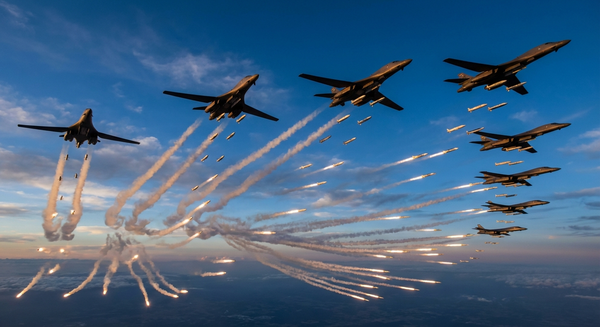
In a significant tactical shift, U.S. B-2 Spirit stealth bombers struck Iranian targets in broad daylight — a first for American operations against Iran.
Previous U.S. strikes, including Operation Midnight Hammer in June 2025 (when B-2s destroyed underground nuclear complexes at Fordow, Natanz, and Isfahan), were conducted under cover of darkness. Iran’s air defense doctrine and alert posture were built around the assumption that American strikes would come at night.
Today’s daytime B-2 sorties sent a deliberate message: Iran’s air defenses cannot detect or stop these aircraft regardless of lighting conditions. The B-2 is the only platform capable of delivering the 30,000-pound GBU-57 Massive Ordnance Penetrator (MOP) — the bunker-buster needed to reach Fordow’s underground facility, buried 80–90 meters inside a mountain.
The White House signaled the B-2 involvement the day before: on Friday, White House official Dan Scavino posted a photograph on social media showing eight B-2 Spirit stealth bombers lined up on a runway — an unprecedented and intentional show of force.
U.S. forces also employed Tomahawk cruise missiles, rocket artillery, drones, and F-35 stealth fighters. Air, land, and sea assets were all involved. American MIM-104 Patriot launchers, THAAD batteries, and ship-launched Standard Missile interceptors defended regional bases from Iranian retaliation. A U.S. official confirmed that no American facilities sustained critical damage and no U.S. casualties have been reported.
Where Things Stand Right Now
This situation is rapidly evolving. As of this writing:
- The U.S. and Israel continue active military operations against Iran — this is the second major joint strike in less than a year
- Supreme Leader Khamenei is reported killed; multiple senior military and political leaders confirmed dead
- Iran has launched retaliatory strikes across the entire region — approximately 35 missiles at Israel, plus attacks on U.S. bases in Bahrain, Qatar, the UAE, Kuwait, Jordan, and Saudi Arabia
- The U.S. Navy’s Fifth Fleet center in Bahrain was hit; Dubai reported loud booms from missile interceptions
- Multiple countries have closed their airspace
- The stated U.S. objectives are to prevent Iran from obtaining nuclear weapons, destroy its missile program, neutralize its naval forces, and topple the Islamic Republic
- Israel says it seeks to “remove existential threats” including Iran’s nuclear and missile programs
- Trump has called on the Iranian people to “take over your government,” saying “this will probably be your only chance for generations”
More Updates to Follow
This is a developing story. We will continue to update as events unfold. Facts are still emerging, and early reports in conflicts like these are often incomplete or contradictory.
Whatever the outcome of the military operations, the people of Iran — who have suffered under decades of sanctions, authoritarian rule, economic collapse, and now military strikes — deserve peace and prosperity. The Iranian people are not their government, and their courage in protesting for a better future has been seen by the world.
Wishing safety, peace, and a brighter future for the people of Iran. 🕊️
Sources: Reuters, NPR, Al Jazeera, The Washington Post, The Guardian, The New York Times, Axios, Business Insider, Institute for the Study of War (ISW), Wikipedia, @WarMonitor3 on X
Last updated: February 28, 2026 — 5:45 PM EST