AI and Social Dandelions: Why Trust Is the Last Durable Competitive Advantage
In the AI era, code and marketing channels are commoditized.
TL;DR: AI commoditized code. SaaS commoditized delivery. Marketing channels are saturated. The last durable competitive advantage is understanding how trust spreads through communities — and it spreads nothing like a virus. It spreads like hybrid corn in 1930s Iowa: slowly, socially, and only when multiple trusted connections vouch for it. The companies that win from here aren’t the ones that build fastest — they’re the ones that master the sociology of trust.
I’ve been writing about the People-Product-Price framework for a while now. In The Trust Moat, I argued that trust is the only competitive advantage left. In SaaS is Dying, I showed how AI broke the math that made software-as-a-service work. In People are People, I told the story of three customer service encounters in a single night that proved the point at the human level.
But I’ve been thinking about the mechanism — not just that trust matters, but how it actually spreads. And a brilliant article by Lewis Kallow on Every connected the dots in a way I hadn’t fully articulated before.
The Best Ideas Don’t Spread. Not at First.
In 1933, Iowa was facing agricultural catastrophe. Then hybrid corn arrived — a miracle seed that could thrive in drought, produce healthier crops, and was easy to harvest. After a year of aggressive sales campaigns, 70% of Iowa’s farmers knew about it.
Less than 1% adopted it.
“A man doesn’t just try anything new right away,” one farmer explained.
Sound familiar? By the mid-1970s, 91% of U.S. drivers knew seatbelts saved lives. Only 11% wore one.
The pattern repeats everywhere. Great ideas — even obviously great ideas — don’t spread the way we think they do. And understanding why is the key to everything that follows.
Simple vs. Complex Contagions
A 2024 review published in Nature Communications finally cracked the code on Iowa’s corn conundrum, building on decades of research including Damon Centola’s groundbreaking work in How Behavior Spreads: The Science of Complex Contagions.
The key insight: there are two fundamentally different kinds of spread.
Simple contagions are low-risk. A funny cat video. A meme. A news article. You see it once, you share it. One exposure is enough. These spread like viruses — fast, far, and through weak ties.
Complex contagions are high-risk. Switching your CRM. Adopting a new development framework. Trusting a new vendor with your infrastructure. Wearing a seatbelt when nobody else does. These require “individuals to make a substantial personal investment due to the costs or risks involved, including reputational or social risks, personal risks, and personal effort.”
For complex contagions, one recommendation is never enough. You need social reinforcement — multiple people in your trusted network vouching for the same thing before you’ll take the plunge.
This is why Iowa’s farmers didn’t adopt hybrid corn after a salesperson visited. It’s why seatbelts took decades. And it’s why the best SaaS sales playbooks from the last era are about to become worthless.
The Death of the Old Playbook
I wrote in SaaS is Dying that AI broke the economic math behind software-as-a-service. But the disruption goes deeper than pricing.
The entire SaaS go-to-market playbook — SDRs, MQLs, drip campaigns, PLG funnels — was designed to create simple contagion dynamics for what is fundamentally a complex contagion. We spent billions trying to make enterprise software adoption feel like sharing a cat video.
It never worked that well. It just worked better than everything else we had.
As Peter Drucker famously said: “The aim of marketing is to know and understand the customer so well the product or service fits him and sells itself.” But in the AI era, when everyone can build the same product in a weekend, “fitting” isn’t enough. You need to understand how adoption actually propagates through human networks.
Density Before Distribution
This was Airbnb’s lesson. In 2008, despite national news coverage from a viral cereal box stunt, the site was making $800 per month. Staying in a stranger’s house is a textbook complex contagion — high risk, high effort, high social weirdness. One news broadcast wasn’t going to cut it.
So the founders flew to New York, met 30 hosts in person over beers, and turned them into evangelists. That tiny dense network became the seed for everything that followed.
Social scientists call the structures that make this work “wide bridges” — when you hear about something from multiple trusted connections, not just one. Wide bridges form naturally inside tight-knit communities where people have overlapping connections.
This is also how OpenClaw exploded. It didn’t go viral in the traditional sense. It spread through dense networks of AI builders who were already talking to each other — in Discord servers, in Telegram groups, in the hallways of AI conferences. Each person heard about it from three or four trusted peers, not from a single ad or blog post.
Social Dandelions
Here’s where it gets tactical. If wide bridges in dense communities are how complex contagions spread, who are the people that build those bridges?
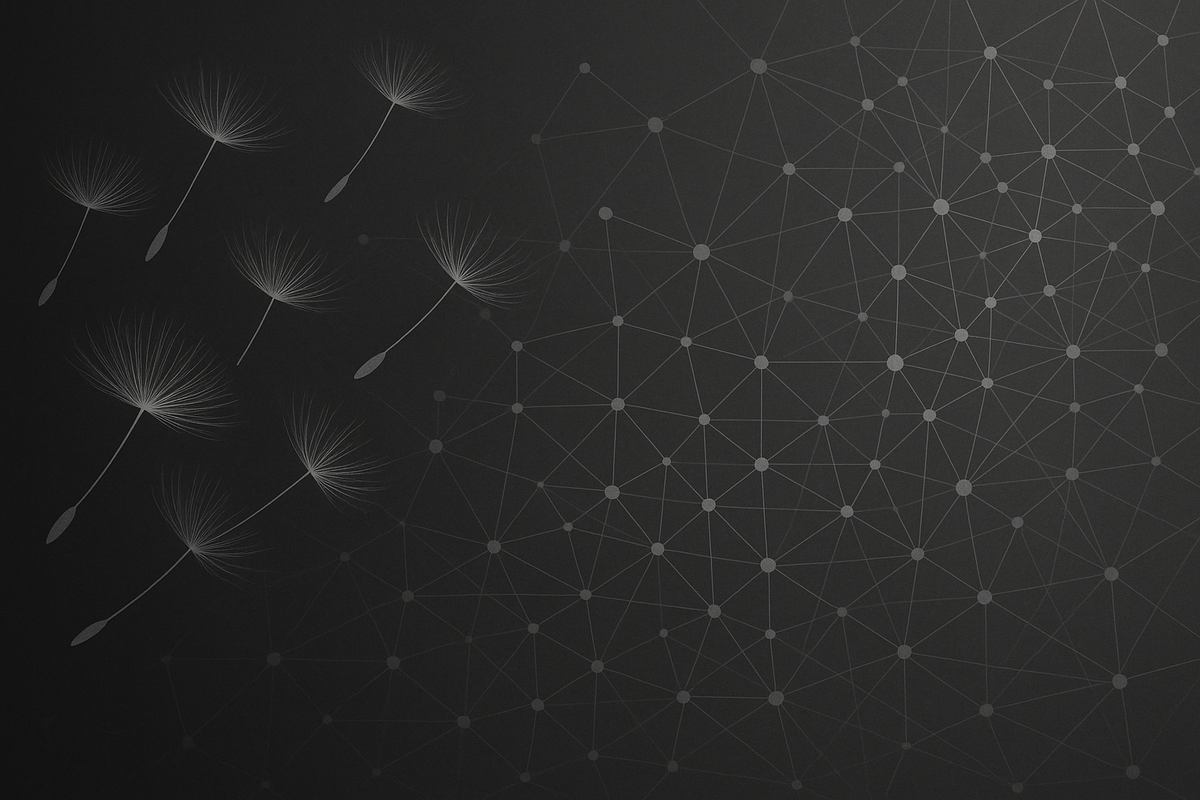
Kallow calls them “social dandelions” — the most socially active, connected people in a community. Not necessarily the highest-status people. Not the influencers with the biggest followings. The people who talk to everyone.
As Malcolm Gladwell described in The Tipping Point: “The success of any kind of social epidemic is heavily dependent on the involvement of people with a particular and rare set of social gifts.” He called them Connectors, Mavens, and Salesmen. Social dandelions are similar — but the research has gotten more specific. It’s not about charisma or influence; it’s about connectivity and activity within a specific community.
Think about who drove adoption of the tools you use today:
- ChatGPT: AI researchers and ML engineers who’d been following OpenAI for years — 135,000 visited on day one, embedded in dense professional networks.
- Midjourney: Spread through Discord art communities where members shared creations daily.
- Slack: Grew inside dev teams at startups, then entire companies adopted it because one team couldn’t stop talking about it.
- Strava: Cycling and running clubs where every member could see what their friends were using.
In each case, the product didn’t go viral to the masses. It went social through a dense community, carried by the most connected members.
The Trust Triangle
So trust is the mechanism. But what is trust, exactly?
In 1995, Mayer, Davis, and Schoorman published An Integrative Model of Organizational Trust in the Academy of Management Review — arguably the most cited trust research in organizational science. They identified three components:
- Ability — the competence to deliver on promises
- Benevolence — genuine care for the other party’s interests
- Integrity — adherence to principles the other party finds acceptable
All three must be present. A company can be competent (ability) and honest (integrity) but if customers don’t believe it cares about them (benevolence), trust doesn’t form.
When Trust Forms: The Failure Test
Here’s the part most companies get wrong: trust is primarily built when things go wrong, not when they go right.
As Warren Buffett put it: “It takes 20 years to build a reputation and five minutes to ruin it. If you think about that, you’ll do things differently.”
When everything works, you’re demonstrating ability. That’s necessary but not sufficient. The moments that build (or destroy) trust are the moments of failure, conflict, or friction — because that’s when benevolence and integrity become visible.
I experienced this firsthand Yesterday in Houston. Three encounters, three hours:
- Sydni at Enterprise stayed past closing at 1:17 AM because she thought I’d be coming. Benevolence made visible.
- Jason at Hilton told me my late flight was “poor planning on your part and not my problem,” then called the police. Integrity absent. Trust destroyed.
- Tabitha at Marriott said she could give me a free room for the night if I wanted 10 minutes; talked with me about why customer service matters. Ability established; All three legs of the triangle complete, at 3 AM.
Every company faces these moments. The ones that build trust moats are the ones that treat failures as opportunities to demonstrate benevolence and integrity, not just ability.
NPS: The KPI That Ate the Stack
In the SaaS era, we obsessed over CAC, MRR, LTV, churn, expansion revenue. Those metrics still matter. But in the AI era, one metric has risen above all others: Net Promoter Score.
Why? Because NPS is the closest quantitative proxy we have for the trust triangle. A Promoter (9-10) is someone who trusts your ability, believes in your benevolence, and has confidence in your integrity — enough to put their own reputation on the line by recommending you.
And in a world of complex contagions, Promoters are your social dandelions. They’re the ones who create wide bridges in dense communities. They’re the ones who drive adoption that no marketing budget can buy.
As Fred Reichheld, the creator of NPS, wrote: “The program isn’t about the program. It’s about earning the enthusiastic loyalty of your employees and customers.”
Forrester Research found that companies prioritizing customer experience generate 5.7 times more revenue than their less customer-centric counterparts. That’s not a rounding error. That’s the difference between thriving and dying.
Slash Friction, Build Bridges
The tactical playbook for the AI era is deceptively simple:
1. Target a narrow, dense community first. Don’t try to go broad. Find your pickleball club — the tight-knit group where wide bridges form naturally. For OpenClaw, it was AI builders in Discord. For Midjourney, it was digital artists. For Strava, it was cycling clubs.
2. Identify and activate your social dandelions. Not influencers — connectors. The people who talk to everyone in the community. Give them something remarkable to talk about — which means investing in the trust triangle, not just features.
3. Slash adoption friction to near-zero. ChatGPT’s genius was a simple chat UI. Granola records meetings invisibly. The lower the friction, the easier it is for a complex contagion to cross the threshold. As Steve Krug wrote: “Don’t make me think.”
4. Invest disproportionately in failure recovery. Every support interaction, every bug, every outage is a trust-building opportunity. This is where benevolence and integrity become visible. This is where Sydnis are made and Jasons are fired.
5. Measure NPS obsessively. It’s your leading indicator of whether trust is compounding or eroding. If it’s below 50, you have a trust problem. If it’s above 70, you have a moat. If it’s above 90, you have an army of social dandelions.
The Bottom Line
AI can build anything. Ergo anyone can build anything. Code is commoditized. The channels are saturated. The SaaS playbook is burning.
What’s left is what was always underneath: how humans decide to trust each other and the things they use. The sociology hasn’t changed — we still adopt complex contagions through dense networks with wide bridges, carried by the most socially connected members of our communities.
The companies that win from here won’t be the ones with the best product or the lowest price. They’ll be the ones that master the trust triangle, cultivate their social dandelions, and understand that in 2026AI — this glorious year After Artificial Intelligence — Net Promoter Score flew to the very top of the KPI stack.
Not because it’s a trendy metric. Because it’s the closest thing we have to measuring the force that actually makes things spread.
As the Nature Communications researchers concluded: “The key insight lies in the fundamental distinction between simple and complex contagions.”
Your product is a complex contagion. Start treating it like one.
References:
- [1] Lewis Kallow, “AI Can Build Anything. Social Dandelions Decide What Spreads”, Every.to
- [2] Nature Communications, “Complex contagions review”, 2024
- [3] Damon Centola, How Behavior Spreads: The Science of Complex Contagions, Princeton University Press
- [4] Mayer, Davis & Schoorman, “An Integrative Model of Organizational Trust”, Academy of Management Review, 1995
- [5] Fred Reichheld, The Ultimate Question 2.0